99% Is Not Good Enough: What Lean Six Sigma Teaches Us About Doing Things Right the First Time
99% sounds excellent until you do the math. 1,000 fibre installations a month at 99% success = 120 failed installations a year. That is why Lean Six Sigma exists: Lean makes a process fast, Six Sigma makes it right.
November 20, 2026 · 5 min read · 3 views
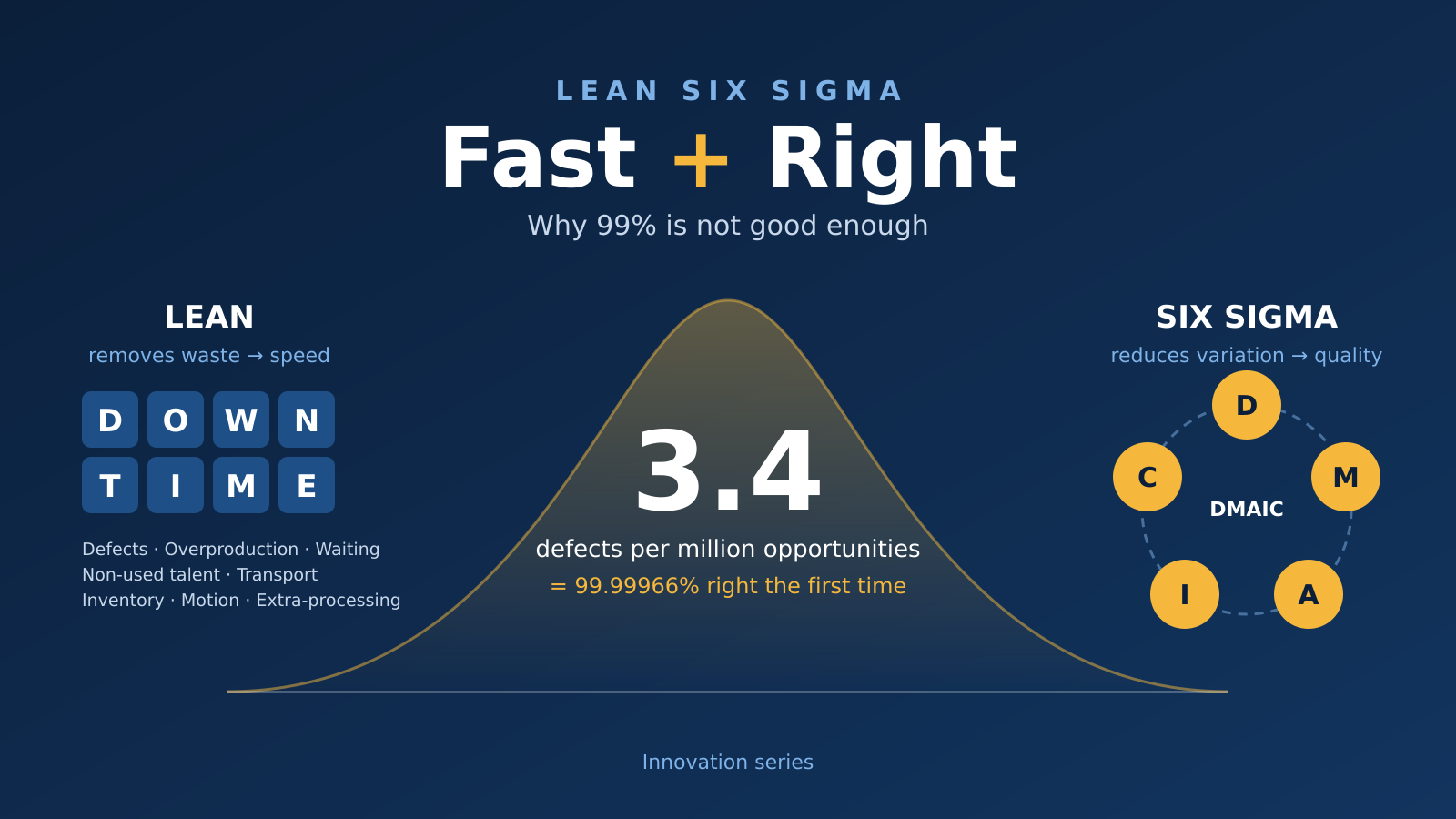
When we talk about innovation, we usually picture something new: a new app, a new network technology, a new startup. But some of the most powerful innovations are not about inventing new things. They are about doing the things we already do faster, better, and right the first time. That is the promise of Lean Six Sigma. The problem with "almost perfect" Imagine a telecom operator that connects 1,000 fibre customers every month. If 99% of installations succeed, the team will probably celebrate. But do the math: that is 10 failed installations every month, 120 every year. Each one means a technician sent back on the road, a complaint at the call centre, extra cost, and maybe a customer who leaves for a competitor. At small scale, 99% looks excellent. At the scale of a national network, a bank, or a hospital, 1% of failures becomes thousands of unhappy people. This is exactly the problem Six Sigma was created to solve. Six Sigma: the science of consistency Six Sigma was born at Motorola in 1986, developed by engineer Bill Smith with Dr. Mikel Harry and the support of CEO Bob Galvin. The name comes from statistics: sigma (σ) is the standard deviation, the measure of how much a process varies. A process running "at six sigma" produces no more than 3.4 defects per million opportunities, which is 99.99966% right. The key idea is simple and powerful: defects come from variation. If you measure variation and control it, you control quality. The results made the method famous. Motorola won the first Malcolm Baldrige National Quality Award in 1988. In 1995, Jack Welch made Six Sigma the centre of General Electric's strategy, and GE reported savings that grew from $350 million in 1998 to more than $1 billion. Six Sigma is not a slogan. It is a step-by-step method called DMAIC:
- Define the problem from the customer's point of view.
- Measure it with real data.
- Analyze the data to find the root cause, not just the symptom.
- Improve the process by removing that cause.
- Control the new process so the problem does not come back. Lean: the art of removing what does not add value A process can be accurate and still painfully slow. That is where Lean comes in. Lean comes from the Toyota Production System, and its goal is to maximise value for the customer while removing everything that does not add value. Lean practitioners hunt eight types of waste, easy to remember with the word DOWNTIME: Defects, Overproduction, Waiting, Non-used talent, Transportation, Inventory, Motion, and Extra-processing. Look around any organisation and you will find them: forms filled in twice, tickets waiting for an approval, engineers whose ideas nobody asks for, reports that nobody reads. Fast + Right: why the combination works In the 2000s, companies started combining both approaches into Lean Six Sigma. The logic is easy to remember: Lean makes a process fast. Six Sigma makes it right. Lean Six Sigma makes it fast and right. Lean without Six Sigma can give you a fast process that still makes mistakes. Six Sigma without Lean can give you a precise process that is slow and heavy. Together, they attack both waste and variation, using the same structured DMAIC method. What it could look like in a telecom operation Take a common pain point: the time it takes to repair a fibre fault. • Define: customers complain that repairs take too long. The goal is to reduce the mean time to repair (MTTR). • Measure: collect data on every ticket: time to dispatch, travel time, time on site, how many repairs needed a second visit. • Analyze: the data may show that most of the delay is not the repair itself, but waiting for spare parts or a technician going back because the first diagnosis was wrong. • Improve: keep the most-used spare parts in field vehicles (Lean: less waiting) and give the call centre a standard diagnosis checklist (Six Sigma: less variation). • Control: follow MTTR every week on a simple control chart, and react as soon as it drifts. No new technology, no huge budget. Just data, discipline, and a team that looks at the process with fresh eyes. It is not magic: three honest limits
- It can become bureaucratic. Not every small problem needs a full DMAIC project. Sometimes a quick improvement workshop (Kaizen) is enough.
- It depends on good data. If you measure badly, you will improve the wrong thing.
- It needs leadership. Without real commitment from management, Lean Six Sigma becomes a training certificate instead of a culture. My takeaway In Africa, where resources are tight and customer trust is precious, we cannot afford waste or repeated mistakes. Lean Six Sigma reminds us that innovation is also a mindset: questioning how we work every day and refusing to accept "almost good enough".
1 comment
Paul Emma
Great to read This